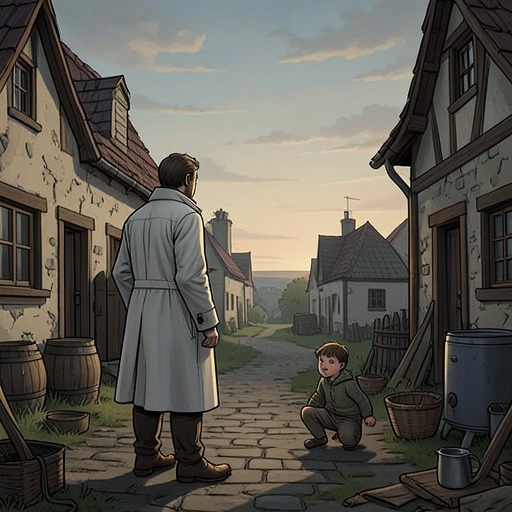
Kensuke’s ship is wrecked and he drifts to a desert island
Kensuke's KingdomKensuke’s ship is wrecked and he drifts to a desert island is the wartime catastrophe that turns a Japanese doctor and naval officer into a long-term castaway. The ship’s destruction leaves Kensuke alive but convinced that his family has been killed; its movement across the sea carries him to an island where he chooses isolation, salvages supplies, and learns to survive. Years later, the rusting wreck on the shore makes this history materially present to Michael, while Kensuke’s account explains the fear and guardedness that govern their first encounters.
Warship, Bombing, and Family Loss
Kensuke recounts his wartime experience to Michael during a fishing trip, presenting the shipwreck as the outcome of a war that had turned against Japan. He says that American aircraft attacked his warship in a major sea battle. The first bombing brought fire and smoke, killed and burned many men, and drove others into the sea. Kensuke remained aboard because he was the doctor and had patients to care for. When the aircraft returned with more bombs, he believed he would die, but survived to find that the patients and sailors around him were dead.
The ship’s engine continued to run, although Kensuke could no longer steer it. He was therefore carried onward without control of its course. Through the radio, he heard that an atomic bomb had fallen on Nagasaki. Because his wife, Kimi, their son, Michiya, and other members of his family were there, he concluded that they had all died. His account places that news beside the loss of his shipmates: the disaster did not only leave him physically alone, but also gave him reason to believe that the family life to which he might have returned no longer existed.
Kensuke also recalls hearing that Japan had surrendered. He says that the news made him so sad that he wanted to die. The engine eventually stopped, but the ship remained afloat; later, a strong wind and storm carried it toward the island. Kensuke believed again that he would die, but the sea brought the vessel onto the beach instead. Survival came through an uncontrolled passage from battle at sea to stranding on an unfamiliar shore, not through a planned escape or rescue.
Wreck, Supplies, and Survival
After reaching the island, Kensuke found food and water and lived there for a long time in severe emotional distress. He describes feeling that he had no wish to live because he thought his friends and family were dead while he alone had survived. The island offered distance from the war, but that distance did not immediately relieve his grief. His account links the start of his new life to a sense of undeserved survival, rather than to any deliberate decision to abandon his former home.
Before the ship was lost, Kensuke took whatever useful things he could find aboard: food, clothes, sheets, pots, bottles, a knife, binoculars, medicine, and tools. He hid these belongings in a cave. The wreck later went onto rocks in a terrible storm and sank. When Michael recognizes the rusting hull he had seen on the island, the discovery connects the visible remnant to Kensuke’s story: the wreck is both the source of the goods that sustained him and evidence of the ship’s final destruction.
The shipwreck did not itself provide a complete means of survival. Kensuke found food and water, made use of salvaged possessions, and gradually learned to live off the island. He later explains that he learned what was safe to eat largely by observing the orangutans, and that he watched how they moved and how they warned one another of danger. He learned to climb and to understand their signals; over time, he formed a bond of trust with them. The castaway’s survival thus develops from immediate salvage into adaptation and relationship with the island’s wildlife.
Isolation and the Island’s Meaning
Kensuke’s arrival is followed by another encounter with human beings, but it deepens rather than ends his isolation. He says that American soldiers came to the island. He hid in the forest with the orangutans because he did not want to surrender and considered surrender dishonorable; he was also afraid. From hiding, he heard the soldiers say that everyone in Nagasaki was dead and heard them laugh. That experience reinforced his belief that his family had been killed and helped confirm his decision to remain on the island after the soldiers left.
By the time Kensuke tells Michael this story, the ship is underwater, partly covered by sand and incorporated into the island’s landscape. This physical change matters to the account: the vessel that once carried him through war has become a concealed trace of the world he left behind. Michael’s recognition of its rusting hull gives the story a tangible point of connection between the island’s present and Kensuke’s past, even before the full significance of the wreck is known.
Kensuke says that after the soldiers departed, no more men came for many years. His shipwreck therefore leads not to a brief pause before return, but to prolonged self-imposed isolation. He does not forget Kimi or Michiya, yet continues living on the island. His wartime survival and mistaken belief about his family help explain why he later regards other people as dangerous and resists Michael’s presence. The wreck is consequently a turning point with consequences that extend well beyond the moment the ship reaches shore: it begins a life shaped by loss, concealment, adaptation, and attachment to the orangutans.